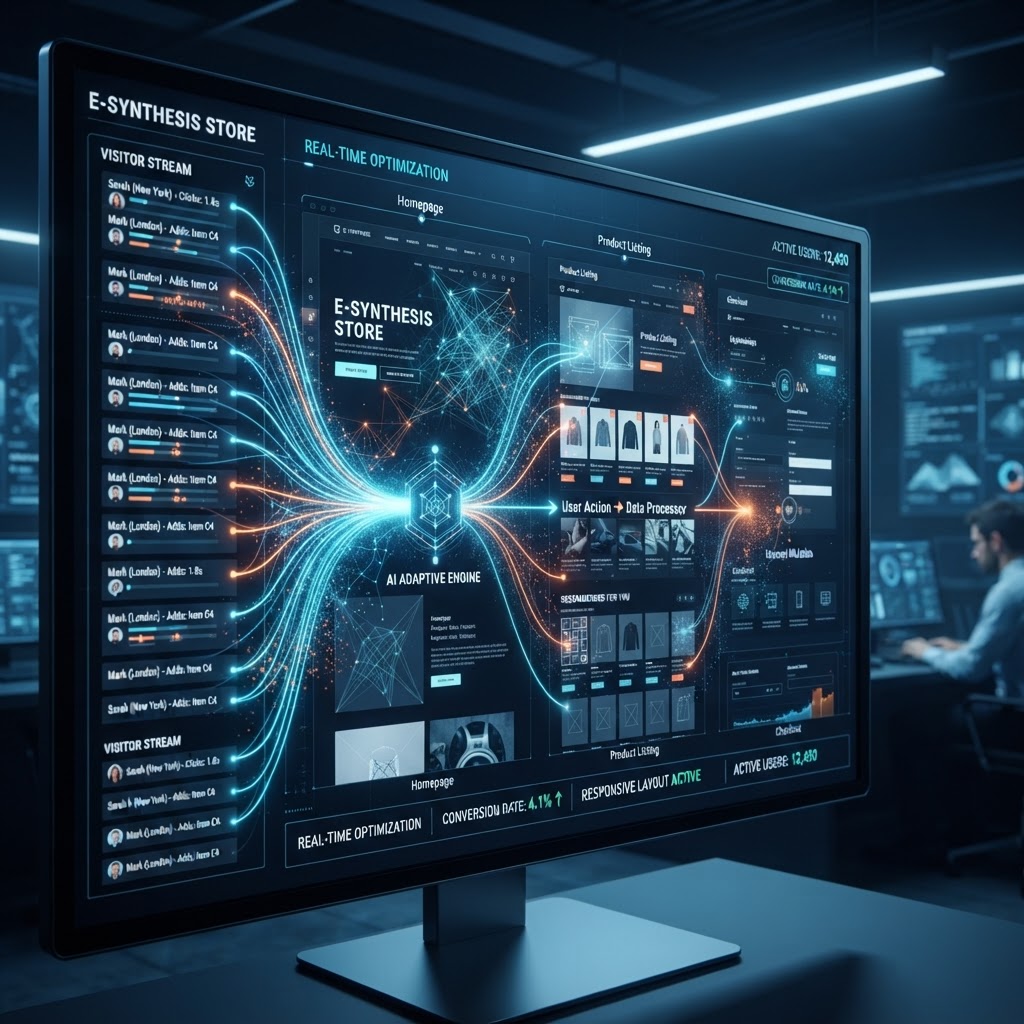
Beyond the Funnel: Why AI Agents Are the New Architects of the E-commerce Experience
For decades, the marketing funnel has been the North Star for e-commerce growth. We visualized the customer journey as a wide mouth narrowing down to a single point of conversion: awareness, interest, desire, and action. But in the hyper-fast world of 2025 and beyond, this linear model is showing its age. Customers no longer move in straight lines; they bounce, loop, disappear, and reappear across channels with unpredictable intent.
As marketing managers and growth hackers, we have traditionally used website personalization as a tool to patch the leaks in this funnel. We might swap a headline or trigger an exit-intent popup. However, we are now witnessing a fundamental paradigm shift. Personalization is no longer just a feature we add to a static site; it is becoming the architect of the site itself. We are moving away from fixed funnels and toward Autonomous Journey Loops managed by sophisticated AI agents.
The Fall of the Linear Funnel
The traditional funnel was built for a world of limited touchpoints. In that world, marketers could manually map out a logical path for a user to follow. Today, the sheer volume of data makes manual mapping impossible. A user might see an Instagram ad, research on a desktop, compare prices on a mobile app, and finally convert via a personalized email link weeks later.
When we attempt to force these non-linear behaviors into a linear funnel, we create friction. Static A/B testing and broad segmentation are reactive; they tell us what worked for a majority of people in the past, but they fail to address what a specific individual needs right now. This is where AI marketing steps in to replace the rigid funnel with a dynamic, self-optimizing loop.
Entering the Era of the Autonomous Journey Loop
In an Autonomous Journey Loop, the AI agent does not just follow a predefined path—it creates the path. Instead of a marketing manager deciding that a user should see a '10% off' coupon after 30 seconds, the AI agent analyzes behavioral targeting signals in real-time to determine the optimal intervention. This includes managing messaging, timing, and channel selection dynamically.
These loops are recursive. Every interaction—a hover, a scroll, a click, or even a hesitation—feeds back into the model to refine the next millisecond of the experience. The AI agent acts as a digital concierge, moving the user through a cycle of engagement, validation, and conversion that feels less like a sales process and more like a tailored service.
Personalization as the Architect: Generative UI and Adaptive Copy
The most profound shift in this new era is the rise of Generative UI (User Interface). Historically, web design was a 'one-to-many' endeavor. You built a landing page, and everyone saw it. With AI as the architect, we are entering the world of 'one-to-one' real-time site generation.
Imagine a visitor landing on your e-commerce site. An AI agent detects their referral source, their past browsing history, and their current mouse movements. In real-time, the agent rewrites headlines using adaptive copywriting to match the user’s specific psychological triggers—focusing on 'social proof' for one user and 'scarcity' for another. Simultaneously, the generative UI might reorder the product grid, highlighting items that match the user’s aesthetic preferences or even adjusting the color palette to increase visual comfort. The website is no longer a static document; it is a fluid, temporary environment built specifically for that single session.
Predictive Intent and the Power of Micro-Conversions
Growth hackers know that the path to a final sale is paved with micro-conversions: adding an item to a wishlist, viewing a sizing chart, or spending a specific amount of time on a shipping policy page. Traditional analytics tell you these things happened after the fact. AI marketing, however, uses predictive intent modeling to forecast these actions before they occur.
By utilizing AI-powered heatmaps and automated session replay analysis, these agents can detect user hesitation. If a user’s cursor patterns suggest they are confused by a checkout field, the AI doesn't wait for them to bounce. It intervenes immediately—perhaps by launching a real-time chat window or simplifying the UI on the fly. This shift from reactive to anticipatory marketing ensures that the 'next best action' is always teed up, drastically reducing the friction that kills conversion rates.
Navigating the Risks: Authenticity, Data, and Privacy
While the potential for growth is immense, moving to an autonomous model requires careful navigation of new risks. As marketing managers, we must ensure that the 'human touch' isn't lost in a sea of algorithms. If a site becomes too fluid, it can lose its brand identity, feeling uncanny or untrustworthy to the user. Maintaining a consistent brand voice within adaptive copy is paramount.
Furthermore, the accuracy of an autonomous journey is only as good as the data feeding it. Poor data inputs—such as siloed customer information or inaccurate tracking—will lead the AI to build the wrong journeys. Finally, the collection of high-frequency behavioral signals must be balanced with a privacy-first approach. Transparency in how data is used to enhance the experience is the only way to maintain the long-term trust required for high-LTV customer relationships.
Conclusion: The Future is Autonomous
The transition from a static funnel to an autonomous journey is not just a technological upgrade; it is a shift in mindset. It requires moving away from the desire to control every step of the customer path and instead trusting AI agents to architect the most effective route to conversion in real-time. For e-commerce site owners, this means higher conversion rates, lower acquisition costs, and a level of website personalization that was previously unimaginable.
The question is no longer how to get people through your funnel. The question is: how quickly can you deploy the AI agents that will render the funnel obsolete?
Ready to move beyond the static funnel?
Discover how 1976 PE can transform your e-commerce experience with autonomous, AI-driven personalization.