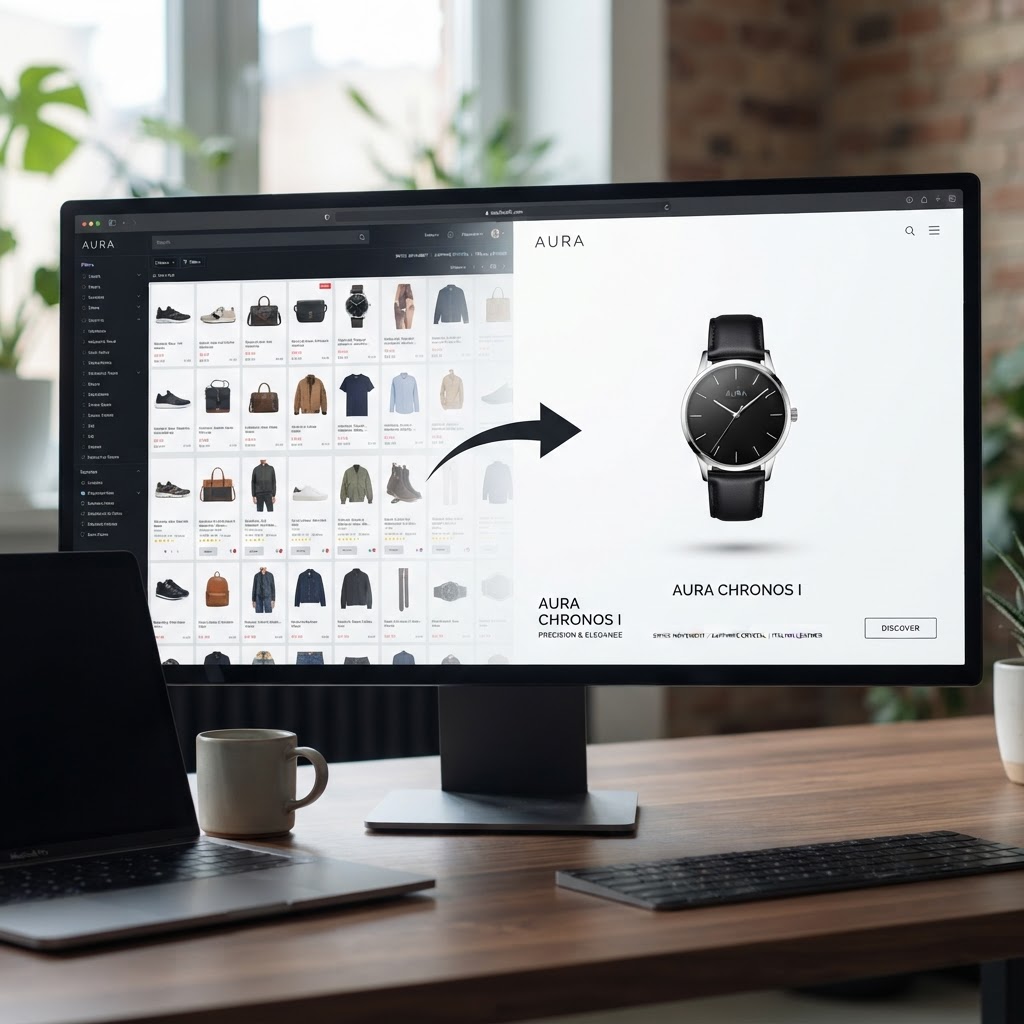
The Hidden Friction: When More Options Lead to Fewer Sales
In the early days of e-commerce, the value proposition was simple: variety. Digital storefronts promised an 'endless aisle' where every conceivable product was just a click away. However, as we move further into the decade, we are discovering that this abundance has a dark side. For the modern consumer, the abundance of choice has transitioned from a luxury into a cognitive burden known as decision fatigue.
Decision fatigue occurs when the sheer volume of options exhausts a user's mental energy, leading them to defer the decision entirely—usually by bouncing from your site. In the world of conversion rate optimization, we often focus on what we can add: more social proof, more urgency timers, more related products. But the most sophisticated CRO strategies for 2026 and beyond are shifting the focus toward subtraction. By using AI to filter out the noise, brands can transform their website from a cluttered warehouse into a curated boutique.
Beyond Collaborative Filtering: The Rise of Real-Time Relevancy Scores
For years, the gold standard of personalization was collaborative filtering—the ubiquitous 'Customers who bought this also bought' widget. While effective in the 2010s, this method is fundamentally reactive. It relies on historical data that may have no bearing on a user’s immediate, real-time intent. If a customer is shopping for a gift, their past purchase history of office supplies is irrelevant noise.
At 1976 PE, we are pioneering the shift toward AI-driven Relevancy Scores. Instead of looking backward, our engine analyzes real-time clickstream data—the sequence of pages viewed, the dwell time on specific images, and even the micro-movements of a cursor—to predict immediate intent. This allows the system to assign a dynamic score to every SKU in your catalog for that specific session. The result? We don't just show 'related' items; we show the only items that matter to the user in that exact moment.
The Strategy of Subtraction: Simplification as a Cognitive Aid
Most conversion rate optimization tools act as messaging layers that sit on top of your site, adding more elements for the user to process. 1976 PE functions differently. We view our personalization engine as a cognitive aid that simplifies the buyer’s journey by removing distractions.
1. Real-Time Homepage Curations
Rather than a generic hero banner and a standard grid of 'New Arrivals,' 1976 PE adapts the homepage in real-time. If a user arrives via a search for 'waterproof hiking boots,' the engine can instantly suppress fashion sneakers and sandals, bringing technical outdoor gear to the forefront. By hiding irrelevant categories, you reduce the 'decision time'—the interval between landing and the first meaningful action.
2. Streamlining the Product Detail Page (PDP)
The PDP is often the most cluttered part of an e-commerce site. Between upsells, cross-sells, and reviews, the primary 'Add to Cart' goal can get lost. AI-driven relevancy allows us to prune these recommendations. If the data suggests a user is highly price-sensitive, the engine might suppress high-ticket cross-sells that could cause 'sticker shock' and instead display value-driven alternatives that keep them in the funnel.
Optimizing for the 'Buy Trifecta'
Effective CRO strategies cannot look at conversion rates in a vacuum. A high conversion rate is worthless if it destroys your margins or alienates your best customers. At 1976 PE, we focus on the 'Buy Trifecta': increasing Conversion Rate (CR) while simultaneously protecting Average Order Value (AOV) and long-term Customer Lifetime Value (CLV).
The risk of aggressive personalization is the 'filter bubble'—a scenario where a user only ever sees one type of product, capping your ability to cross-sell into new categories. To combat this, our AI utilizes a 'controlled exploration' model. It reserves a small percentage of the UI for 'discovery' items that sit just outside the user's predicted intent. This prevents the experience from feeling claustrophobic while still maintaining the benefits of a streamlined path to purchase.
The Future of CRO: Balancing Automation with Authenticity
As we look toward 2026, the industry is splitting. Some consumers will opt for 'AI delegation,' where they allow agents to handle the shopping for them. Others will crave 'authentic personal experiences'—the feeling of being understood by a brand without feeling like they are being tracked by a robot.
The challenge for marketing managers is to ensure that AI-driven subtraction doesn't feel like cold automation. The messaging must remain human. 1976 PE allows brands to overlay their unique voice onto AI decisions. For example, instead of a generic 'Recommended for You' heading, the engine can trigger brand-aligned copy that explains why a selection was made, bridging the gap between data-driven efficiency and human-centric storytelling.
Overcoming Technical Debt and Implementation Hurdles
One of the primary reasons growth hackers hesitate to implement deep personalization is the fear of technical debt. 'Drop-in' tools that don't talk to your CRM or data architecture often create more problems than they solve. 1976 PE was built to be 'data-agnostic,' meaning it integrates seamlessly with your existing stack. By aligning with your current architecture rather than overriding it, we ensure that your personalization efforts remain fast, scalable, and—most importantly—accurate.
Conclusion: Less is More
In a world of noise, the most valuable thing you can give your customer is clarity. By moving away from the 'more is better' philosophy of the past and embracing the strategy of subtraction, you can significantly reduce decision fatigue and skyrocket your conversion metrics. AI-driven relevancy scores are no longer a luxury; they are a fundamental requirement for any brand serious about conversion rate optimization.
Is your website helping your customers choose, or is it getting in their way? It’s time to stop adding and start refining.
Ready to see the power of subtraction in action?
Discover how 1976 PE can simplify your customer's journey and drive measurable growth.